One Future
Living within environmental limits
Respecting the limits of the planet's environment, resources and biodiversity- to
improve our environment and ensure that the natural resources needed for life are
unimpaired and remain so for future generations
Ensuring a strong, healthy and just society
Meeting the diverse needs of all people in existing and future communities,
promoting personal well-being, social cohesion and inclusion, and creating equal
opportunities for all
In Mahatma Gandhi’s words:
“Be the change you want to see in the world”
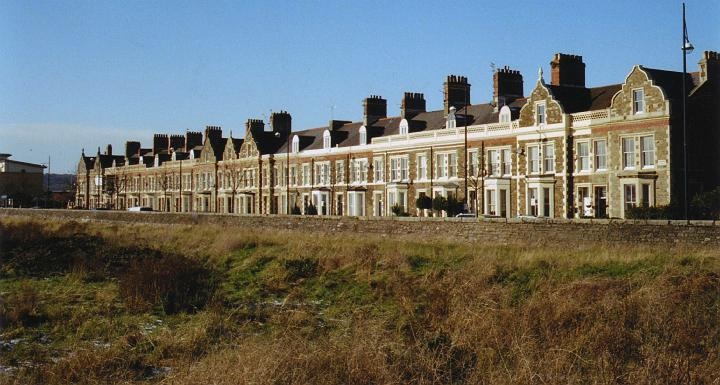
'Sea Captains Houses' overlooking the old
saltmarsh of Cardiff Bay
1 Need for new
subjects
Education for
sustainability is a challenge and a struggle to cut across
traditional divisions created in the West to support a culture
based on the exploitation of limitless natural resources. in
particular, a new interdisciplinary logic of environmental
management is needed to maintain the flows of limited resources. It
is not adequate to simply incorporate environmentalism as a
perspective within existing subjects. Ecology is the central focus
for environmental management of the non-human (natural) habitats
from which we draw biological and physical resources to feed
our technologies. However, environmental management is a
complex phenomena, which involves not just non-human habitats
but also human subjectivity, and social relations, all of which
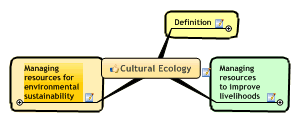
are intimately interconnected. Cultural ecology brings these
three 'ecologies' together as a provisional mind map to
connect the natural environment with self and society.
Often, critical work
on our profligate use of planet Earth's resources emerges as a
series of interventions into established disciplines and
practices. This reveals a fundamental need to assemble new
knowledge systems which deal with the future of our species as one
ecological community boxed into a relatively small niche in
evolution.
This is evident in
the trend to expand the boundaries of subject divisions. For
example, arising from the great diversity of modern
approaches to archaeology has come the need to develop a
theory of persons within a more general theory of organisms and
environment. Similarly, metallurgy includes a view of
household waste as a new 'ore' to maintain a supply of scarce
materials. These trends point the way to a general
educational framework that would link together subjects in a common
knowledge system of human life, consciousness and environment. This
would be a form of cross- disciplinary systems thinking, where
social, economic and material concepts are regarded as being
embedded in ecological relations. The aim is to help build
theoretical and practical bridges with the practical aim of
facilitating cultural change to sustain the human condition
as a global society. Cultural ecology joins up practical
approaches, from many starting points, for managing the environment
in an overcrowded world. There is no single cultural ecology
syllabus because each person has their own predilection and passion
for a particular set of guiding principles and
concepts. The mindmap presented here is a provisional attempt
of one group of people in Wales to produce a global picture where
environmental management is the bridge between mass production and
conservation.
2
Principles
-
information is presented as an
integrated collection of topics that defines the points of
balance between conservation managementand exploitative
management.
-
living sustainably requires the
production and circulation of new ecological meanings and
values.
-
environmental management should be at
the centre to help young people claim a right to see the past
differently.
-
human history is a continuous process
of reinterpretation and transformation of the
environment.
-
the past has to be reconstructed, not
only to recover traditions which have been misrepresented or
rendered invisible, but to search for meanings and images which
prefigure current concerns about the
environment.
-
we are part of nature and every social
action, idea, and rule has appeared in the context of many
millennia of primate evolution through natural
selection.
-
material conditions are not only
determined by a combination of environment and technology.
They arise and persist through cultural learning of values applied
to resources.
3 Economic
perspective
Cultural ecology
centres on cultural-economic and cultural materialist approaches to
environment.
Cultural-economic
views stress how value is created through the exchange of goods and
services. Cultural- materialist approaches extend this to
consider the expression of environmental values as symbols, such as
sacred lands. These symbols are the educational currency for
establishing social obligations to selected elements of nature as
part of a social feed-back system to legitimise ecosystems that
have been embodied with meaning.
4
Origins
Culturalecology.info
has its origins in the Faculty of Science at Cardiff during the
early 1970s where new cross- disciplinary degrees were created to
redirect academic trajectories
towards ecocentrism.
It was given a boost
by the University of Cambridge Examination Syndicate in the 1980s,
where it was assembled as a new GCE subject natural economy, and
developed as a model for world development education with a grant
from the Directorate General of the EC. This was
delivered for evaluation in the pioneering experiments with the
European schools OLYMPUS satellite education
programme.
In the late 1990s
where the topic framework was consolidated around environmental
management as part of the LIFE Environment
programme.
Current developments
are being made by the UK Conservation Management System Consortium
in partnership with organisations concerned with bringing
environmental management to the centre of education for
sustainability at all levels.
The project is part
of a wider online mixture of educational resources about
sustainability knowledge organised to manage the environment
responsibly.
Denis Bellamy (1999)
University of Wales Professor Emeritus of
Zoology,
Department of Biodiversity and Systematic
Biology,
National Museum, Cardiff
The Cultural Ecology knowledge framework is
now being promoted and developed by RESILIENCE-UK