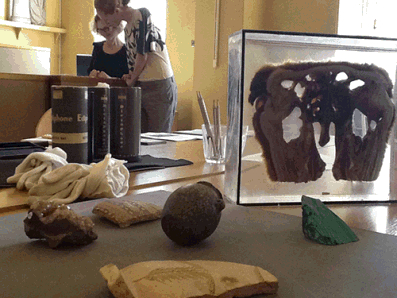
Objects or artefacts
form the core of museum learning. Handling them gives us
‘active learning’. The objects used give us information
and the relationship that artefacts have with each other and the
situation in which they are found gives us their context.
They can connect a moment in time, a person’s life, a set of
values and beliefs.
Objects are what
people left behind and can tell us about themselves, about the
people who used them, about change and about the past. They can be
powerful tools to help deliver the new National Curriculum for
Wales which emphasises the importance of skills development in
learning. As well as extending knowledge, they can be used to
develop skills such as: investigation, evaluation, historical
understanding, forming an opinion, speaking and listening. Objects
can be used to inspire for all learning styles if used in a variety
of ways and it is important that we address this when looking at
how to use our collections.
Objects can become
passageways from past to present. Before they became public
institutions, museums started first as private and personalized
collections, or cabinets of curiosities and wonder. The first
museums started as haphazard collections of fascinating things, of-
ten existing in glass cases in people's homes as jumbles of natural
history objects, manuscripts, artifacts, and ephemera. A
contemporary museum's collection of objects is just as haphazard
and may be representative more of "local wonders" than any sort of
universal ones. In turn, the information housed in museum
collections may be just as fleeting as any idea is within a
learner's mind. A museum collection can teach visiting students
that objects are representative of the transitory nature of ideas.
The similar impermanent nature of both ideas and objects connect in
the state of wonder that both incur in the learner. Just as a
wonderful idea connects the learner to his specific time and place,
a wonderful object does as well. This similarity of their wonder is
the stuff of meaningful learning.
The challenge for
museums, and the process of heritage management more generally, is
one of finding ways of engaging creatively with these objects so as
to facilitate their ongoing relationships with people and the other
objects around them in the future. This means opening up a dialogue
with heritage objects, places and practices as actors in their own
right, rather than perceiving them merely as props that stand in
for human cultures from the past, in the present.
The following
discussion involved Katy Barrett who is Curator of Art pre-1800 at
Royal Museums Greenwich and former convenor of the CRASSH seminar
series, 'Things', at Cambridge University, Dr Lucilla Burn is the
Keeper of Antiquities at the Fitzwilliam Museum, Mark Elliott is
Senior Curator at the Museum of Anthropology and Archaeology,
Cambridge and the poet Daljit Nagra who recently took part in
Thresholds, a creative residency programme at Cambridge University
museums.
What
can we learn from objects?
Katy
Barrett:
Objects give us a
special kind of access to the past. They allow us to touch (within
careful parameters usually) something that was used by people, and
thus get a physical feel for their lives. We can learn about past
societies' values from what they kept, and what materials they made
things from - or about daily life from such simple things as
cooking utensils and furniture. Objects bear the marks of how
they've been used, giving us access to ideas that may have been too
fundamental to a person's life ever to have been written down. The
wear and tear on books can show us how people read them, with some
even showing the rust marks of the knife used to cut the pages in
an era when text was printed on large sheets of paper which were
folded the size of the finished book.
Lucilla
Burn:
As Katy says,
objects can provide a very tangible link between us and people of
past societies. Besides the insights they can offer into
contemporary art, craft and technology, trade or settlement
patterns, they can also illuminate individual lives. In the
Fitzwilliam collection, for example, a roughly-cut and not very
grammatical inscription on a Roman funerary urn, explaining how an
ex-slave had acquired it to hold her own ashes and those of her
beloved husband, with whom she had lived for 23 years, provides not
just important evidence for social mobility in the 1st century CE
but also a direct glimpse of a bereaved individual whom we would
know nothing about if she hadn't bequeathed us this
'object'.
Mark
Elliott:
For me, objects can
be simultaneously more and less expressive than any number of
words. There's an immediacy in an encounter with a material thing
that is right in front of us, whether it's separated by a pane of
glass or not. Some things are easier to interpret than others. One
of my favourite objects in the Museum of Archaeology and
Anthropology is a brick from the city of Babylon that has the seal
of King Nebuchadnezzar II stamped on it, but also a
beautifully-formed footprint. You can instantly imagine how this
happened, and it can lead you to think about how cities were built,
how people worked, or the politics of sixth-century BC Babylon.
Sometimes the clues are easier to read than others: I think the
most valuable lesson objects can teach us is how to really look.
Everything follows from there.
Daljit
Nagra:
From a poet's
perspective, museums are a sensual resource to the past. In the
hands of great poets this resource becomes a valuable tool. I think
of Seamus Heaney finding metaphors to help him negotiate the
Troubles in Northern Ireland, in particular his great poems about
the peat bog finds in Denmark. Heaney opens one poem: 'Some day I
will go to Aarhus...' and this visit to a museum feels like a dream
of accomplishment as he tries to appreciate the bog bodies as a way
of understanding our past so we can move forwards positively.
Perhaps museums can help us become ourselves at our
best.
Why
do we go (or not go) to museums?
KB
I'm glad that
museums seem to be going from strength to strength in visitor
numbers. Most of us will go to see the treasures housed in national
museums when we go on holiday, or flock to the growing number of
blockbuster exhibitions to see these treasures on tour. But we run
the risk of forgetting our local museums and permanent collections
through focusing on these 'once in a lifetime' experiences. Museums
can also be the heart of communities, preserving important local
and national stories, which reward you with new ideas every time
you visit. The Bridewell Museum, for instance, highlights the
vibrant industries in the history of the city of Norwich. They are
great for visits with family and friends to inspire interests and
discussions. We need to put to bed permanently the view of museums
as elitist, hide-bound institutions. The Hepworth in Wakefield -
the kind of contemporary art museum, which you might expect to be
particularly elitist - is a hub for local residents on a
Sunday.
LB
While I clearly have
a vested interest in attracting as many people as possible to the
Fitzwilliam, I think that realistically we need to face the fact
that museums, like music festivals, opera, rock-climbing,
bird-watching or football matches, are not to everyone's taste, and
also that people's relationship with them is likely to ebb and flow
at different periods of their lives. I agree it's interesting that
many people who expect to visit museums when on holiday don't drop
into their local museum at the weekend. One of our challenges, and
something museums spend a lot of time on, is creating special
events and exhibitions that will give local audiences the incentive
to come in and enjoy something 'new'. Many Cambridge students are
'non-visitors' to Cambridge museums - they would probably say they
are too busy....but maybe (to take a positive and global
perspective) the local student deficit is made up for by their
holidaying counterparts from Spain or Italy?
ME
This is actually a
really hard one. Many of us probably have an idea about why we go
to museums ourselves, or indeed why other people might go. But the
truth is none of us are really sure. Our experience of a museum,
and our reasons for being there in the first place, can depend on
so much: the people we are with, the mood we are in, or how much we
want to spend on activities that day. But 'why' we go to museums
doesn't really matter as much as what we get out of our visit. We
may go to see a famous artwork, and end up meeting someone special.
We may go to get out of the rain and come face to face with an
artefact that changes the way we think, or lifts us somehow;
something that sets us on a wholly new journey of discovery. That's
why I go to museums: because they are where the unexpected
happens.
DN:
I would feel better
about museums if I felt they had a strong focus in winning over
students from 'ordinary' backgrounds. I studied at a school where
pupils took CSEs rather than O levels, I remember never visiting a
museum, and when I visited the British Museum, as an adult, I felt
intimidated by the aloof joyless manner of the entrance. I felt
there was a code of self-presentation that I needed to rapidly
adopt so that I looked as though I fitted in. On a positive note,
at the Cambridge Museum of Archaeology and Anthropology, I heard
students from a socially deprived
comprehensive
school, similar to the one I went to, gasp as they heard the
Education Officer, Sarah-Jane Harknett, blowing their minds away
with the significance of flint. Yes, flint of all
things!
Can
digital collections replace real objects?
KB
Online access
increasingly rules how we approach information today and museums
have to engage with this to stay relevant. Some museums have put a
lot of work into making their collections accessible online with
high quality images and a good depth of information. The British
Museum in London and Rijksmuseum in Amsterdam are notable examples.
They allow visitors to access information outside of the museum,
and researchers to use collections more effectively. Admittedly
this requires a commitment of substantial financial resources, but
it also needs vision and staff investment in creating digital
content. Seeing a picture, however, can't ever replace material
engagement with an object. We can't anticipate the kinds of
questions we'll want to ask of objects in the future, so a digital
record should never take the place of an object or image. There's
no replacement for the real thing, as any excited group of visitors
around a museum handling table will show you.
LB
Obviously museums
are keen to capitalise on the possibilities offered by the
internet. It's a great way of extending access, and apart from
collections databases there are lots of other opportunities to
exploit its possibilities - online exhibitions, for example, can
remain on view indefinitely after the physical show has been
dismantled but also give people the opportunity to examine works of
art in greater detail than they can in the gallery: see for example
the exhibition that accompanies the current Fitzwilliam exhibition
of Japanese prints, 'The night of longing' -
http://www.fitzmuseum.cam.ac.uk/gallery/nightoflonging/index.html.
It's helpful and potentially exciting for everyone, from interested
members of the public to scholars working on the other side of the
world, to be able to explore a museum's collections remotely. But
the short answer to this question is of course 'no!' Digital
collections can enhance what museums have to offer but can never
substitute for the physical presence of the real
thing.
ME
No. But they can do
a lot of the same things, and indeed they can do things that 'real'
objects can't. A reproduction of an artefact, whether it's a
photograph or a digital version of it, for example, can travel much
further than the artefact itself. It can be in many places at once
and so dramatically enrich the conversations that surround it. You
lose something when you are engaging with a work of art or a
specimen on a computer screen. You can't walk around it, or touch
it, or see how light plays upon its surface. It can be hard to
appreciate the scale of something - whether it's incredibly
delicate or whether it dominates the room. In fact that room and
the people in it is incredible important - Katy mentioned the
excited crowds in her gallery, and it's the communal effect of the
crowd gathered around an exhibit that is so special.
DN From the
perspective of a writer, I wish more museums around the world
offered an exciting online experience. My poems and my verse-novels
are heavily research-based and as I have young children and a busy
day-to-day schedule online accessibility would enrich my creative
work. Digitalised museums are not a replacement for the real thing
but should be an alternative reality.
Who
should have what?
KB
The long histories
behind many European museums inevitably involve legacies of
colonialism, war and expropriation. Collections include objects
with complex pasts that were acquired in settings very different
from today. This means that museums now care for objects with
contested ownership which, at least UK national museums, are
legally prevented from de-accessioning. The sector has developed
guidelines for returning particularly sensitive objects, such as
human remains or objects expropriated in the Nazi era. Likewise,
countries have a process of export bars to stop objects of national
significance passing out of the country through sale. Museums need
to be sensitive to the pasts of their objects in these ways, as
much as in how they interpret them, but what would be the point of
museums if they all contained only locally produced objects? Surely
one point of museums is to showcase the strange and the foreign as
well as the local and familiar? Cultures and nations don't develop
in isolation, objects help us to tell stories of entangled
histories, and to compare very different cultural
developments.
LB
This is an enormous
and quite unanswerable question which Katy has answered very
well.... I would just like to add, rather tangentially, that while
requests for repatriation can make headline news, the useful
relationships and collaborative programmes of research and outreach
frequently developed between colleagues in museums or countries
that might popularly be supposed to be at cultural loggerheads are
very often overlooked.
ME
None of us who work
in museums would want to be apologists for the sometimes murky
processes by which objects entered our collections in the past.
Even when the transactions were honest and equal, the descendants
of people who once owned an object in a museum can of course feel a
sense of loss. But often, through the kinds of relationships that
Lucilla mentioned (relationships that only exist because objects
from 'there' are 'here'), some really important conversations, and
new understandings, can develop. In this way, as others have said,
the artefact can be an 'ambassador' of sorts - forging and renewing
relationships between people separated as well as united by a
common history.
DN
I agree with Katy
and Lucilla and would only add that perhaps items, if they were
acquired dubiously, should be judged on individual merit as to
whether they should stay here or be returned to their source. Some
cultures do not have a tradition of visiting museums, some
countries do not fund their museums well, and some countries are
deeply unstable and prone to conflict, so in all these cases I am
glad that the objects are safe in British museums.
Q5
In a notional
disaster scenario, which collection or museum would you
rescue?
KB For me it would
have to be the Sir John Soane Museum in London, it's a glorious gem
of a collection, a museum in miniature. I love house museums that
give you a sense of the person behind their creation. At the Soane
you feel that you've stepped straight into the eighteenth century,
almost into the brain of Sir John Soane, thanks to his eclectic
collection of architectural fragments and designs. What a way to
learn about architectural history! Soane also had a spectacular
painting collection, which includes the two famous series by
William Hogarth, A Rake's Progress and An Election. They're
displayed in his original painting room, hung on layers of hinged
walls that are specially opened daily. You can even visit by
candlelight once a month to experience the house as his dinner
guests might have.
LB
I think I'm
forbidden by the terms of my contract from saying anything other
than the Fitzwilliam - but if I can have two choices, please might
I also rescue the Isles of Scilly Museum? A refuge for
holiday-makers on rainy days, it's a wonderful place to glimpse and
marvel at the resourceful lives of generations of Scillonians - and
the evidence for others who passed, or attempted to pass, through
Scilly - from the brooches and coins left by Roman traders, to the
poignantly personal possessions salvaged from the many wrecks that
ring the islands. Harrowing first-hand accounts of maritime
tragedies make for compelling reading, while equally absorbing are
the sepia photographs of 19th-century tourists, embarking in wildly
impractical clothing on the same pleasure trips that visitors take
today. A pilot gig rigged with oars and sail, ancestor of those now
rowed by the islanders for sport, forms an impressive centre-piece
to the displays and drives home the Museum's central message, that
the life of the islands has always both depended on - and been
threatened by - the sea.
ME
This is a cheat of
an answer, but I would save a collection that I haven't seen, and
don't know about: the small collections of objects, experiences and
histories that are made in households, villages and communities
throughout the world - in shoe boxes, in living rooms or in
community spaces. Keep collecting, people! But also keep coming to
museums and sharing your stories.
DN
I love the Cambridge
Museum of Archaeology and Anthropology! This beautifully small
museum is packed full of amazing objects from the four imagined
corners of the globe such as textiles, stones, paintings,
sculptures, masks, weapons and skins. I suspect we would be able to
construct the whole history of mankind and mankind's relationship
to the planet with a few of the MAA's objects spanning hundreds of
thousands of years.