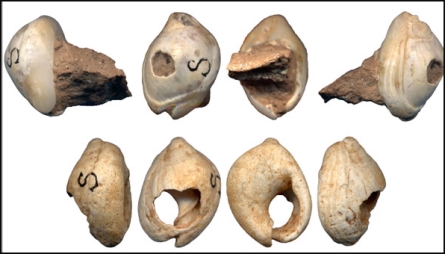
Prehistoric shell beads from Skhul,
Israel
Objects bear the
marks of how they've been used, giving us access to ideas that may
have been too fundamental to a person's life ever to have been
written down
Katy
Barrett
The UNESCO
Convention for the Safeguarding of the Intangible Cultural Heritage
defines cultural heritage as the practices, representations,
expressions, knowledge and skills of people living in a particular
place. It is represented in objects artefacts and cultural
spaces associated with them – that communities, groups and
individuals recognize, through collecting and inventorising, as
contributing to their present. This heritage is transmitted from
generation to generation and is constantly recreated by communities
and groups in response to their environment, their interaction with
nature and their history. It provides them with a sense of
identity and continuity, thus valuing their environment and
promoting respect for cultural diversity and human
creativity.
1
When did collecting objects begin?
Our lives are bound
up with objects. Museums are evidence of our deep preoccupation
with the things that surround us, whether natural or the product of
human endeavour. Why do we keep stuff, what do we learn from it -
and what does our fascination for objects from our past tell us
about being human today?
There's something
innately human about our desire to gather, sort and display things.
Not just to trade in objects or put them to use in a practical
sense - but also to use them to create stories about ourselves.
Most people have a collection of some kind at some point in their
lives. Indeed, historical studies show that acquiring and retaining
objects, even when they are not necessary for survival, is not only
nearly universal, but also has been part of human behaviour since
the earliest human societies. For example, beads made of basalt
deposited in graves in the Fertile Crescent date to the end of the
Upper Paleolithic, beginning in about the 12th to 11th millennium
BC. The oldest shell
collection come from excavations in Africa where our species
originated. It consists of 41 shells found at the South African
site of
Blombos Cave dated to 75,000 years ago. Shells modified to wear as a necklace from
other sites in Algeria and Isreal, indicating that anatomically
modern humans from Africa and the Near East created beadwork
traditions well before their arrival in Europe and that there were
human cultures that valued collecting objects in Africa quite early
in time.
Undoubtedly, each
new discovery of ancient beads has important implications for
testing the unique versus multiple emergence(s) of symbolic
thought. Also, the ability to produce and use beads is not peculiar
of modern humans. Late Neanderthals also made and used beads. Are
Neanderthal beads different in some way from those of modern
humans? Were they used for the same
purpose?. We know
they play different functions in different societies (e.g. they may
be used to beautify the body, function as "love letters" in
courtship, or as amulets, exchange media, expressions of individual
and group identity, markers of age, class, gender, wealth, or
social status). It may well be that the identification of these
functions and the way they evolved to address specific needs, is
relevant for the debate on the emergence of cultural
modernity. In other words when the time of the discovery will
be over and a clear pattern appears we will need to refine our
questions and find the real answers. Collecting probably has more
to do with social processes than to human
evolution. Yet
despite the ubiquitous nature of this trait, very little is known
about what drives humans to collect.
The gatherer-hunter
is a self-conscious agent, confronting a world of plants and
animals from which he or she selects those that will furnish
suitable raw materials for consumption. The forager-predator,
merely responds to the presence of environmental objects that are
perceived as food. It is when we say that the environment comprises
stones rather than missiles or hammers, caves rather than shelters,
plants and animals rather than food, air rather than breathing
space, trees rather than ladders and ground rather than platforms,
that we are treating it in a fashion exclusive to ourselves. Such
an environment of essences (the habitat) does not, in itself,
specify either how it is to be exploited, or to what degree of
intensity. That is for us to decide.
Movements of persons
therefore occur with or in relation to the objects to which people
attach themselves. Such everyday movements need to be contrasted
with those dramatically resulting from forcible human displacement,
in which refugees, for instance, take what items they can both for
immediate practical use but also in order either to re-establish or
re-define personal and collective origins. It is suggested that, as
mementoes of sentiment and cultural knowledge and yet also as bases
of future re-settlement, the 'transitional objects' carried by
peoples in crisis inscribe their personhood in flight, but offer
the possibility of their own de-objectification and
re-personalization afterwards.
Inventories are
integral to the safeguarding of intangible cultural heritage
because they can raise awareness about its importance for
individual and collective identities. The process of inventorying
cultural heritage and making those inventories accessible to the
public can also encourage creativity and self-respect in the
communities and individuals where expressions and practices of
cultural heritage originate. Inventories can also provide a
basis for formulating concrete plans to safeguardcultural
heritage.
2 Biology of
collecting behaviour
An interview with
researchers at the University of Iowa
Hoarding behavior is
common among animals; around 70 species hoard and mostly they hoard
food, which makes sense from a survival standpoint. Studies of
hoarding behavior in rodents have shown that collecting is driven
by certain primitive structures deep in the brain and most mammals,
including humans, share these subcortical regions.
"But human
collecting goes beyond items that are solely useful for survival,"
said Steven Anderson, lead author of the study. "People often
collect art or stamps or pretty much anything. Clearly there is
some higher structure in humans that modulates the collecting drive
and that's what we think we have tapped into."
By studying patients
who developed abnormal hoarding behavior following brain injury,
neurologists in the University of Iowa Roy J. and Lucille A Carver
have identified an area in the prefrontal cortex that appears to
control collecting behavior. The findings suggest that damage to
the area causes abnormal hoarding behavior by releasing the
primitive hoarding urge from its normal restraints. The study was
published online in the Nov. 17 Advance Access issue of the journal
Brain.The UI team studied 86 people with focal brain lesions - very
specific areas of brain damage - to see if damage to particular
brain regions could account for abnormal collecting behaviour.
Other than the lesions, the patients' brains functioned normally
and these patients performed normally on tests of intelligence,
reasoning and memory.
A questionnaire
completed by a close family member was used to identify problematic
collecting and the behaviour was classified as abnormal if the
collection was extensive; the collected items were not "useful" or
aesthetic; the collecting behavior began only after the brain
injury occurred; and the patient was resistant to discarding the
collected items.
The questionnaire
very clearly split the patients into two groups - 13 patients who
had abnormal collecting behavior and a majority (73 patients) who
did not. Unlike normal collecting behavior such as stamp
collecting, the abnormal collecting behavior of these patients
significantly interfered with their normal daily life. Patients
with abnormal collecting behavior filled their homes with vast
quantities of useless items including junk mail and broken
appliances. Despite showing no further interest in the collected
items, patients resist attempts to discard the
collection.
To determine if
certain areas of damage were common to patients who had abnormal
collecting behavior, the UI researchers used high-resolution,
three-dimensional magnetic resonance imaging to map the lesions in
each patient's brain and overlapped all the lesions onto a common
reference brain.
"A pretty clear
finding jumped out at us: damage to a part of the frontal lobes of
the cortex, particularly on the right side, was shared by the
individuals with abnormal behavior," Anderson said. "Our study
shows that when this particular part of the prefrontal cortex is
injured, the very primitive collecting urge loses its
guidance.
"This finding sheds
some light on a ubiquitous, nearly universal human behavior that we
really don't know much about, and we can use this as springboard to
think about normal collecting behavior."
Anderson added that
the findings also may have implications for understanding certain
neurological conditions such as obsessive-compulsive disorder (OCD)
where abnormal collecting behavior occurs but the patient has no
readily detectable brain defect.
"Patients with OCD
and some other disorders such as schizophrenia, Tourette's syndrome
and certain dementias, can have similar pathological collecting
behavior but we don't have a pointer to locate where in the brain
the problem is occurring," Anderson said. "Our hope is that our
findings with these brain lesion studies will lead to insights in
these conditions as well."