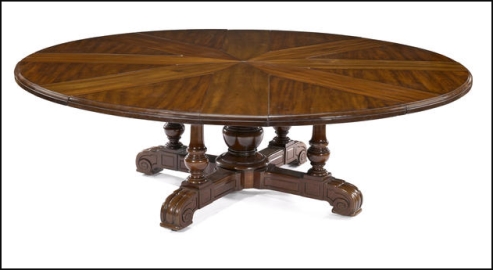
Mahogany table circa 1839
Foreign craftsmen
(Dutch and French) arrived in Britain following the accession of
William of Orange and his wife Mary (the daughter of James II), in
1689. William of Orange was Dutch and hence a great deal of Dutch
influences entered into English life. Fine cabinetmaking, walnut
and ebony veneers and florals. Legs are turned to trumpet shapes or
scrolled and scroll develops into cabriole leg by the end of
William's reign in 1702.
William and Mary
furniture was graceful and decorative, it had a well-developed
sense of display and articulation. There was much use of ornate
decorative effects on surfaces such as veneering, parquetry,
lacquer, and marquetry, particularly in side tables. This was the
beginning of the era of the cabinetmaker and men such as Gerrit
Jensen excelled at very fine inlay and marquetry work. Cabinets, as
well as writing bureaus and escritoires, gained domed tops, and
were set on heavily baroque style stands with doric columns, as
were tables.
Chairs were set on
turned legs whose stretchers were tied and curved and mirrored the
carving decoration of the crest at the back. Upholstered chairs had
square back rests and supports separating them from the seats and
their upholstering was more ample and comfortable.
Walnut was very much
in demand by the immigrant Dutch and French furniture makers of the
William and Mary period. Oak was rapidly sliding into country
obscurity and mahogany was just making its very first inroads.
There was also use of kingwood and amboyna for inlay work and ebony
was used for very fine, fancy pieces such as looking glasses and
curio cabinets.
The history of
mahogany logging is linked inseparably to the history of
colonialism. Prized originally by European furniture makers for its
dark colour, stability and ability to be carved in scrolls without
breaking, mahogany was first targeted shortly after Columbus
invaded the New World.
The history of mahogany logging is also a history of deforestation
in the Caribbean and Central and South America. The wave of logging
that began in the 1500s and has expanded out from the original
point of European invasion of the Americas, and continues to this
day, is nearly identical to the expansion of the mahogany
frontier.
There are numerous
species of mahogany and a number of other species of trees called
'mahogany' in trade. Generally, “true” mahoganies are
those in the genus Swietenia, the species of which are
found throughout the Caribbean and Central and South America.
However, species from Africa in the
genus Khaya are also considered mahoganies as they
are distantly related.
Swietenia
There are four
species of Sweitenia in Latin America: Caribbean
mahogany (Swietenia mahogani), Honduran or Pacific
Coast mahogany (Swietenia humilis), bigleaf or
big-leafed mahogany (Swietenia macrophylla) and
Venezuelan mahogany (Swietenia candollei). There is
much confusion as to their common names, with bigleaf mahogany
often being called true mahogany, geniune mahogany, South American
mahogany or Honduran mahogany. Local common names include acajou
and caoba.
Swietenia mahogani, known as Caribbean, Cuban or true
mahogany, is found from the tip of southern Florida and throughout
the West Indies. Swietenia humilis, known as Honduran
mahogany, is found on the Pacific coastal region of Central
America. Both of these species are listed in Appendix I of the
Convention on Trade in Endangered Species of Flaura and Fauna,
known as CITES. This means that countries trading in these species
need to verify that sources are legal and sustainable and all trade
must come with paperwork showing origin.
The majority of the trade in mahogany is currently
bigleaf, S. macrophylla. This species is now listed on
Appendix II of CITES after decades of lobbying by environmental
groups and counter-lobbying by industry groups.
Natural range of
bigleaf and Honduran mahogany in South America.
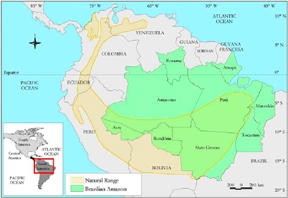
Bigleaf
ranges from the north of the State of Veracruz to Yucatan in
Mexico, along the north Atlantic slope of Central America to
Venezuela and Brazil. It also occurs in Colombia, Peru, and Bolivia
at elevations of up to 4900 feet (1500 m), and on Cape Verde
Islands.
Natural range
of bigleaf and Honduran mahogany in Central
America.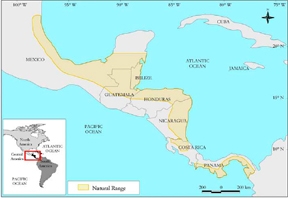
Bigleaf
mahogany is an emergent tree, growing to heights of over 150 feet
and diameters of 6 feet. It is a sun-loving tree, rapidly growing
in clearing and then reaching heights that take its crown above the
canopy.
The US is the largest importer of mahogany by volume and by dollar
value. US demand helped to decimate the populations of Caribbean
and Honduran mahogany. Later, big-leafed mahogany was targeted,
first mostly in Central America. US mahogany imports from around
1900 to 1960 were almost entirely from Belize and
Mexico3. Mahogany in these countries has been reduced to
third-rotation trees that are still being cut, often illegally,
before they even mature.
US imports from 1960 to 2002 were largely from Brazil, Bolivia and
Peru. Since Bolivia's change in forestry law, exports of mahogany
have fallen. From 1995 to 1998, U.S. imports from Bolivia decreased
by two-thirds, while U.S. imports from Peru surged nearly
fourfold4. Further, with Brazil's recent crackdown on
illegal mahogany logging (after decades of calls by environmental
organizations) and Bolivia's shift to mostly certified logging
operations, since 2002, Peru has become the largest exporter to the
US. Much of the logging there is illegal, as most of it was in
Brazil and much of it in Bolivia.
In Peru, mahogany's range has shrunk by 50%, and, within a decade,
a further 28% will be logged out.5
African Mahogany
Typically Khaya ivorensis, but also other species in
the Khaya genus are sold as African mahogany, including K.
anthotheca, K. grandifoliola, and K.
senegalensis.
Khayas are grand trees, reaching heights of 110 to 140 feet with
trunk diameters of as much as 6 feet.
Khayas are found from the Ivory Coast to Gabon and Cabinda, and are
primarily found in the Ivory Coast, Ghana, and Nigeria. The largest
exporters to the US are Ivory Coast and Ghana.
Sapele (Entandrophragma cylindricum) is sometimes
sold as African mahogany and ranges through
Cameroon and
Democratic Republic of Congo
(Zaire).
These species are heavily targeted by illegal loggers in Africa and
as well, many of these countries allow for overlogging that is not
sustainable. IUCN lists these species as vulnerable in much of
their range, due to overlogging.