Fountains,
cascades, ruins, rockwork and shells, morsels of architecture with
bizarre and picturesque effects, intriguing, extraordinary
forms” so states the Mercure de
France in 1734 on the publication of a book of Rococo
designs by the foremost exponent of the style. Juste-Aurèle
Meissonier.
The text could have
added “fabulous birds and exotic chinamen in a visual
fantasy”, for the Rococo is all this: the most amusing,
light hearted and extravagantly charming of all
styles.
Rococo or "Late
Baroque", is an 18th-century artistic movement and style, affecting
many aspects of the arts including painting, sculpture,
architecture, interior design, decoration, literature, music, and
theatre. It developed in the early 18th century in Paris as a
reaction against the grandeur, symmetry, and strict regulations of
the Baroque, especially of the Place of Versailles.
Rococo artists and architects used a more jocular, florid, and
graceful approach to the Baroque. Their style was ornate and used
light colours, asymmetrical designs, curves, and gold. Unlike the
political Baroque, the Rococo had playful and witty themes. The
interior decoration of Rococo rooms was designed as a total work of
art with elegant and ornate furniture, small sculptures, ornamental
mirrors, and tapestry complementing architecture, reliefs, and wall
paintings. The Rococo was also important in theatre. The
book The Rococo states that no other culture "has
produced a wittier, more elegant, and teasing dialogue full of
elusive and camouflaging language and gestures, refined feelings
and subtle criticism" than Rococo theatre, especially that of
France. Rococo was a style developed by craftspeople and
designers rather than architects. This helps to explain the
importance of hand-worked decoration in Rococo design.
The Rococo style was
used primarily in furniture, silver and ceramics, rather than
architecture. It takes its name from the French rocaille
(pronounced 'rock-eye'), which means the rock or broken shell
motifs that often formed part of the designs. Rococo was
fashionable from about 1730 to 1770.
Natural motifs are a
feature of both British and French Rococo. However, in British
Rococo designs the natural motifs are often more realistic in their
details than those on French Rococo designs.
Rococo was a style
developed by craftspeople and designers rather than architects.
This helps to explain the importance of hand-worked decoration in
Rococo design. Rococo design is often not symmetrical - one
half of the design does not match the other half. Curved
forms are common in Rococo. They often resemble the letters S and
C.
The earliest rococo
forms appeared around 1700 at Versailles and its surrounding
châteaux as a reaction against the oppressive formality of
French classical-baroque in those buildings. In 1701 a suite of
rooms at Versailles, including the king's bedroom, was redecorated
in a new, lighter, and more graceful style by the royal designer,
Pierre Lepautre (1648-1716). Versailles remained the creative
center of the rococo until Louis XIV's death, in 1715, after which
the initiative passed to Paris.
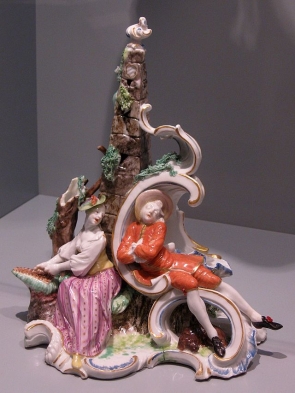
Germany's great
contribution to the rococo style was the rediscovery (1709-10) of
the Chinese art of porcelain manufacture (see pottery and
porcelain) at Meissen, near Dresden. Meissen ware achieved enormous
popularity, and soon every major court in continental Europe had
its own porcelain factory. Small porcelain figures such as those
made by Franz Anton Bustelli (1723-63) at Nymphenburg (see
Nymphenburg ware) are perhaps the quintessence of the rococo,
fusing all its qualities into a single miniature
art.
The rococo style
began to decline in the 1760s, denounced by critics who condemned
it as tasteless, frivolous, and symbolic of a corrupt society.
Within 20 years it was supplanted, together with the baroque, by
neoclassicism.