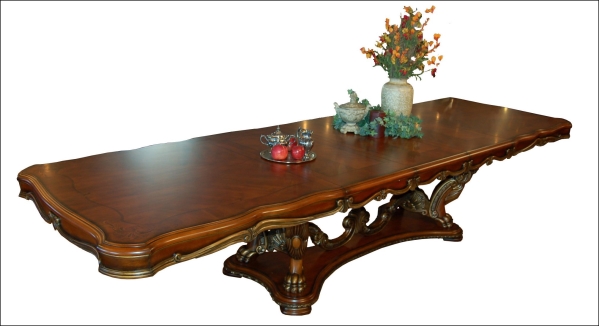
Rococo style mahogany dining table
Rococo furniture
design began in France during the reign of Louis XIV and flourished
during the reign of Louis XV. Being the origin of the design, the
French had great influence on the design and their pieces exhibited
complex and twisting patterns that had curves almost in all
directions. They produced elegant and beautiful pieces with
detailed knowledge and expertise on the use of veneer. The designs
were mostly framed with ‘ormolu’ (gilded bronze) and
the columnar legs of the baroque were replaced with animal-form
legs. The intricacy of the curved designs of the animal-form legs
denotes their expertise in the rococo design.
The English rococo
took a little shift from the French design. The English cabinet
makers designed the ‘cabriole’ (a curving leg tapering
into a decorative foot) for chairs, tables and chests. There were
diversified designs of furniture in England at this time; some
chose to follow designs that were classical and tilted towards the
architectural style called the ‘Palladian’ in which
Renaissance designs of the Italian 16th-century architect Andrea
Palladio were reinvented to suit the 18th Century England. The
English cabinet makers and those they influenced handled wood with
an appreciation of their characteristic traits. The English cabinet
makers were more concerned about creating the rococo feelings and
effects using paints to achieve the effects of the inlays and the
‘ormolu’. Cabinet makers in Europe and other parts of
the world chose this pattern because it was cheaper than the
detailed work and the expensive materials employed in the French
rococo. The London cabinetmaker William Vile, who was employed by
the Crown in the 1750s and 1760s, made some classical furniture
along with rococo work. In the ‘The Gentleman and Cabinet
Maker’s Director (1754)’, a book of furniture designs
written by London cabinetmaker Thomas Chippendale, he presented the
English interpretation of the rococo design and explained other
forms of the design from other nations.